Wardrobe Organization in Singapore HDBs and Condos: What Actually Works
How do you actually organize a wardrobe in a small Singapore HDB room?
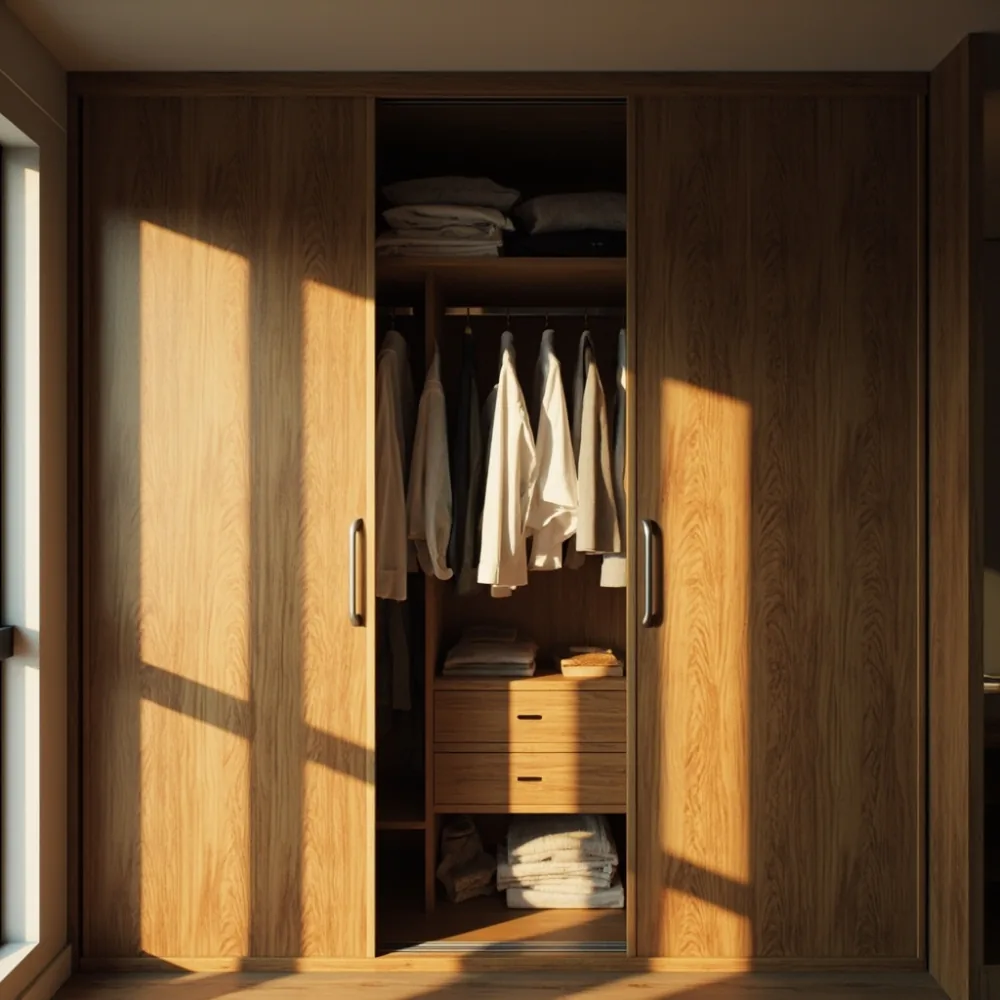
Measuring your alcove in cm
Choosing between sliding and hinged doors
Zoning by clothing type
I have organized wardrobes in three different HDB flats around Bishan, Tampines, and Jurong, and the first lesson is always the same: measure the alcove in centimeters before you measure your hopes. Most HDB bedroom alcoves run between 180 cm and 220 cm in height, with widths from 90 cm to 180 cm and depths around 55 cm to 60 cm. That 5 cm to 10 cm of leftover depth is where wardrobes fail, because a standard 60 cm hanging rail eats all the space and your door will not close cleanly.
Inside that box, I treat the wardrobe like three vertical zones. The top 35 cm to 45 cm is dead space for everyone under 175 cm, so I send suitcases, out-of-season bedding, and archival boxes up there. The middle 120 cm to 150 cm is the daily-use zone, with a full hanging section at 165 cm from the floor for shirts and dresses, and a folded stack zone at waist height. The bottom 30 cm to 40 cm is shoe and laundry territory.
- Top zone: 35-45 cm, hard storage, label everything
- Middle zone: 120-150 cm, hanging plus folded stacks
- Bottom zone: 30-40 cm, shoes, laundry basket, hidden safe
What wardrobe depth and width actually fit a Singapore condo bedroom?
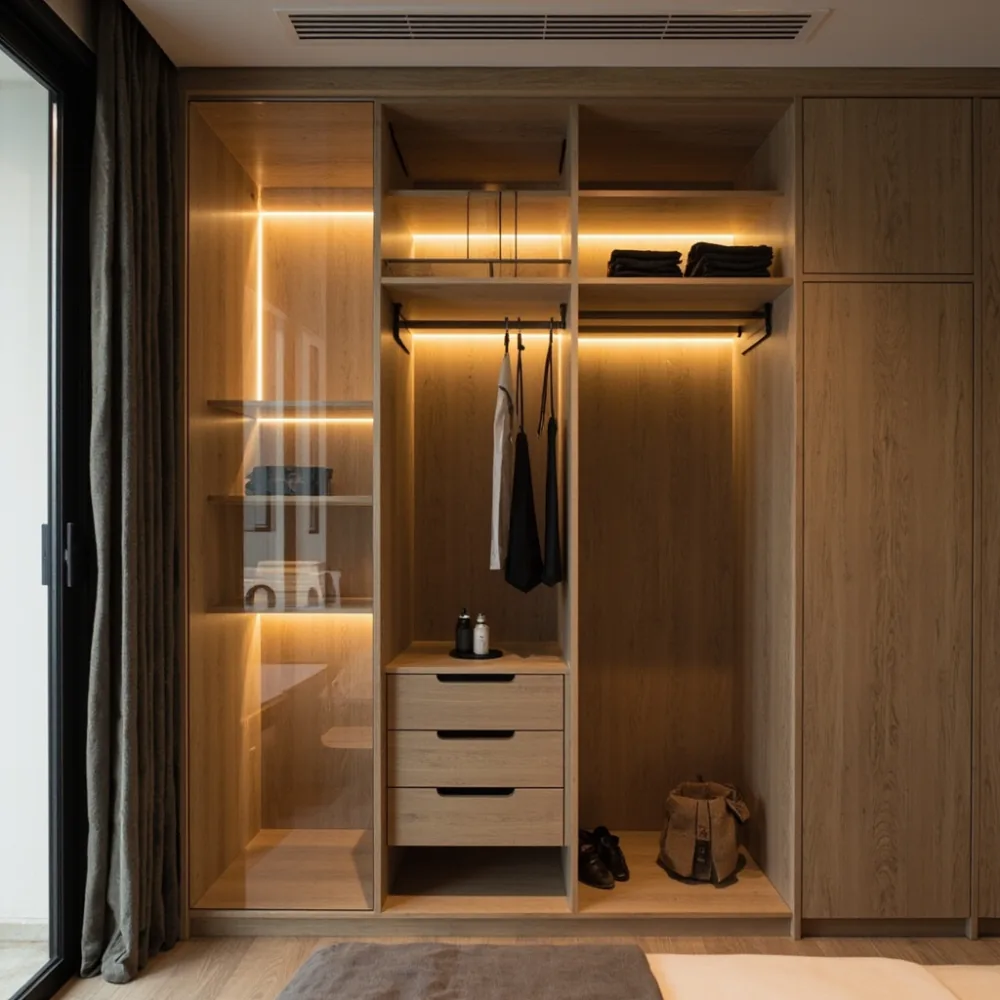
Reading floor plans in cm
Account for ceiling fans and downlights
Allow 60 cm of clearance for the door swing
Condo bedrooms in District 9, 15, and the newer Punggol launches are usually smaller on paper than you remember from the show flat. A typical master bedroom in a 538 sq ft one-bedder is around 3.2 m by 3.0 m, and after the bed, two side tables, and a 55 cm walkway, the wardrobe wall is often only 220 cm to 260 cm long.
For that wall, I default to a wardrobe depth of 58 cm, not 60 cm. The 2 cm saves the door handle from clipping the bedside table. Width depends on whether you go sliding or hinged. Sliding doors need 5 cm of overlap per pair, so a 240 cm sliding wardrobe loses 10 cm of usable interior. Hinged doors need 55 cm to 60 cm of swing clearance, which is fine if the bed sits at least 1 m away.
| Layout | Width | Depth | Door type | Best for |
|---|---|---|---|---|
| HDB 4-room standard | 150 cm | 60 cm | Hinged, 3 doors | Couple sharing |
| Condo master bedroom | 240 cm | 58 cm | Sliding, 4 doors | Tight walkway |
| Studio / shoebox | 90-120 cm | 45-50 cm | Single hinged | Single occupant |
| Walk-in (rare in SG) | 200 cm+ | 55 cm per side | Open or sliding | Landed, premium condo |
Does Singapore humidity actually ruin a solid wood wardrobe?
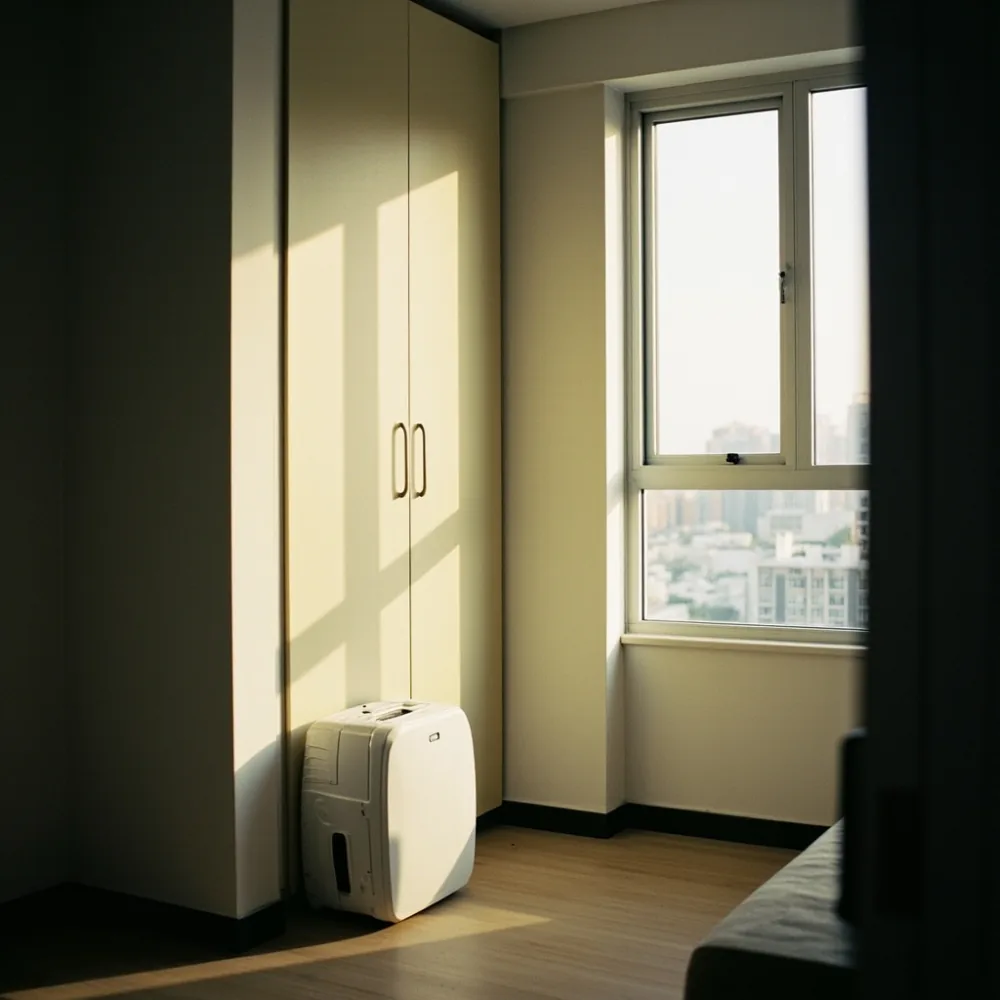
Why engineered panels warp
Why solid wood needs acclimatization
What to do during the monsoon months
After two monsoons in a Bukit Batok flat with a low-quality MDF wardrobe, I watched the side panel bow out by almost 8 mm. The issue is not humidity per se, it is that MDF and particleboard absorb moisture unevenly along the cut edges, then swell and never fully recover. In Singapore, where relative humidity sits at 70-85 percent for half the year, this is a daily stress test.
Solid wood behaves differently. It still moves with humidity, but it moves as one piece along the grain, so it does not delaminate. The catch is that the wood must be kiln-dried to 8-12 percent moisture content before it leaves the factory, then given 7 to 14 days to acclimatize in your flat before installation. Brands that ignore this step send you a board that cups the moment the air-con stops running. If you are investing in solid wood furniture, ask the supplier for their moisture readings on the batch.
For HDBs on higher floors where afternoon sun bakes the wardrobe wall, I add a 2 cm to 3 cm gap behind the carcass using spacer blocks. That rear airflow cut my wardrobe humidity readings by roughly 10 percent on a hygrometer, and it stopped the musty smell that returned every January.
Should I buy a ready-made wardrobe or commission custom carpentry?
Cost per linear meter in SGD
Lead time and HDB delivery rules
When custom actually pays off
Ready-made wardrobes from local retailers typically run SGD 1,200 to SGD 3,500 for a 180 cm three-door unit, while custom carpentry in Singapore for the same footprint starts around SGD 2,800 and climbs past SGD 6,000 once you add soft-close hinges, drawer packs, and a melamine interior. The gap is real, and the decision usually comes down to ceiling height quirks and the floor plan.
Custom wins when your alcove ceiling is 218 cm, your floor is not level, or you want internal LEDs wired to a single switch. Ready-made wins when the alcove is a standard 240 cm wide by 240 cm high box, because the factory will deliver in 10-14 days and assembly takes 2-3 hours. Custom lead time in Singapore is usually 4-6 weeks from measurement, plus another 2-3 weeks if you change the laminate mid-project.
If you want wood that is neither laminate nor MDF, you can also import custom furniture directly from makers like MIDHILL, a Foshan solid-wood furniture maker established in 2008. Their quoted lead time for a bespoke wardrobe to Singapore is around 35-45 days by sea, and the 10-year structural warranty is uncommon in this category. That timeline works if you are renovating, less so if you need something in the flat next week.
Sliding doors or hinged doors for a Singapore wardrobe?
Floor space math
Track maintenance in dusty weather
Accessibility and child safety
Sliding doors reclaim the 55 cm to 60 cm of swing arc, which matters in a 9 sq m HDB bedroom where the bed sits 80 cm from the wardrobe wall. The trade-off is that sliding tracks collect grit, especially if your unit faces a construction site in a District 23 build-out, and once the wheels clog the doors start juddering. I clean the tracks every two months with a dry toothbrush and a drop of silicone spray. That takes four minutes and doubles the lifespan of the rollers.
Hinged doors give you full access to the interior at once, which sounds trivial until you are hunting for a specific shirt in a packed rail. They also tolerate a slightly deeper 60 cm carcass better because the door does not have to slide past the front edge of shelves. For a couple sharing a wardrobe, I usually push hinged doors unless the room is under 10 sq m.
Soft-close hinges cost about SGD 8 to SGD 15 per door extra, but they stop the slam that wakes light sleepers, and they reduce hinge wear by an estimated 30 percent over ten years based on hinge cycle ratings from common European suppliers.
How do I organize hanging space so nothing falls off the rail?
Hook density per meter
Double-hanging vs single-hanging
Slimline hangers save 4 cm each
Standard 40 cm wooden hangers waste about 4 cm of rail per garment compared to slim 32 cm velvet hangers. Over a 150 cm rail, that 8 cm per side adds up to enough room for two more shirts. I switched all my clients to slim velvet hangers in 2021 and the average wardrobe gained space for 12 to 18 extra pieces without changing the rail length.
For the hanging section itself, I split it into two zones: a 165 cm high full-length area for dresses, coats, and long shirts, and a 90 cm high double-hanging area for trousers, tops, and folded jackets. Double hanging means a second rail mounted 90 cm below the top rail, which doubles capacity on the same wall. The drawback is that you cannot store anything taller than 85 cm in the lower section, so suit jackets must live up top.
Hook density matters more than people think. A standard wardrobe rod holds about 30 kg before it sags at the center, which is roughly 40 to 50 garments on slim hangers. If you exceed that, install a center support bracket at the 50 percent mark. I learned this the hard way when a 180 cm rail bowed 2 cm over eighteen months from a heavy kurta collection.
What is the best internal layout for folded clothes and drawers in a tropical wardrobe?
Drawer vs shelf debate
Anti-moth and dehumidifier placement
Linen storage at the top
Folded clothes want shelves, not drawers, unless you wear formal shirts daily. A 38 cm deep shelf fits two stacks of t-shirts side by side, and you can see everything at a glance. Drawers are for small items that slide around: socks, undergarments, accessories. Anything between is a waste of the drawer slide mechanism.
Drawer runners in the SGD 25 to SGD 60 range last 50,000 to 100,000 cycles, which sounds like a lot until you open a sock drawer four times a day for ten years. That is 14,600 cycles. Cheap ball-bearing runners fail around the 20,000 cycle mark, so budget for branded runners if you want the drawer to survive a decade.
For tropical humidity, place two reusable silica dehumidifier boxes inside the wardrobe, one near the floor and one at shoulder height. Refill them every 4 to 6 weeks. Cedar blocks help with mustiness but do little for actual moisture, so do not rely on them as your only defense. Keep the wardrobe door cracked open for 20 minutes after your air-con turns off if the room feels clammy.
How much should a good wardrobe system cost in Singapore in 2026?
Budget, mid-range, and premium tiers
What drives the price per cm
Hidden costs to budget for
p>I track wardrobe pricing across Singapore every quarter, and the 2026 numbers look like this. A ready-made 180 cm three-door melamine wardrobe from a local retailer sits at SGD 1,200 to SGD 2,200. The same footprint in engineered wood with soft-close hinges lands at SGD 2,400 to SGD 3,800. Full custom carpentry with internal drawers, LED strips, and a tall mirror runs SGD 4,500 to SGD 8,500 installed. Imported solid wood from a Foshan maker like MIDHILL lands at SGD 3,200 to SGD 5,800 landed in Singapore, depending on the timber, which is competitive with local mid-range custom work once you add delivery and assembly.The price drivers are always the same: timber grade, hardware brand, internal complexity, and whether the back panel is 9 mm or 18 mm. A 9 mm back panel saves SGD 80 to SGD 150 but wobbles on impact, while an 18 mm back adds rigidity and survives the next HDB move. Assembly in Singapore costs SGD 150 to SGD 400 depending on access and floor level, and high-floor units above the 15th storey may add a SGD 50 to SGD 120 elevator surcharge for bulky carcasses.
Durability is the other price lever. A durable furniture wardrobe with solid wood carcass and plywood backing will outlast three laminate replacements, which is the right frame for thinking about total cost over a 15-year HDB stay.
Frequently asked questions
What is the standard wardrobe depth in Singapore?
Most Singapore wardrobes run 55 cm to 60 cm deep to match standard hangers. For very tight bedrooms I drop to 50 cm and use slim hangers, but anything under 45 cm forces doors that do not close cleanly and crushes shirts at the front.
Can I install a wardrobe on a HDB wall without hacking?
Yes, freestanding and modular wardrobes are HDB-friendly because they do not require wall hacking. You only need to keep a 5 cm gap from the wall for airflow, and anchor tall units to the wall with two L-brackets to prevent tipping.
How long does custom wardrobe delivery take in Singapore?
Local custom carpentry takes 4 to 6 weeks from final measurement, plus 1 to 2 weeks for installation. Imported solid wood wardrobes from China typically take 35 to 45 days by sea, then another 7 to 10 days for customs clearance and delivery to your door.
Which wardrobe material handles Singapore humidity best?
Kiln-dried solid wood with a proper finish handles humidity best because it moves along the grain without delaminating. Marine plywood is a close second. Avoid raw MDF and particleboard for structural panels, since they swell at the cut edges during the monsoon months.
Should wardrobe doors be mirrored in a small bedroom?
Mirrored sliding doors save wall space and make a small HDB bedroom feel roughly 20 percent larger visually. The trade-off is weight, so specify 4 mm tempered mirror rather than 6 mm glass to keep the sliding mechanism smooth over time.
Questions about specifications, fabric or delivery? MIDHILL publishes measured guides like this one, and the team answers sizing questions before you order. See the full collection or contact the team.