Small Apartment, Calm Home: A Singapore-Specific Wardrobe-and-Furniture Plan That Actually Breathes
Last month I spent a weekend in a 58-sqm two-bedder in Punggol with a friend who had just moved in. The unit came with a corridor 1.2 m wide, a lift lobby that swallowed up half of every delivery, and a built-in wardrobe that dominated the master bedroom wall. Within two hours she had unpacked eight boxes, opened every wardrobe door, and quietly panicked. The space was not small by Tampines standards, but it felt loud. By Sunday afternoon, after we returned one wrong-sized bedside table, borrowed one extra folding hook, and rotated a narrow solid wood bed frame 90 degrees, the same flat felt calm.
Small-space styling in Singapore is its own discipline. HDB corridors measure around 1.1-1.5 m, many condo lifts cap at 1.8 m height, and load-bearing walls behind the wardrobe often cannot be drilled past 40 mm. Add 9% GST on every fixture, an air-con service hatch that eats 20 cm of headroom, and you can see why many buyers panic. The fix is rarely "buy more" or "buy bigger". The fix is a strict 90/10 rule: 90% of the visual weight in solid wood furniture you keep for years, and only 10% in soft items you can swap. Below is the full plan I walked my friend through, including a few pieces she later sourced from MIDHILL.
1. Map the unit before you measure a single piece of furniture
Before she touched a single catalogue, we pulled out a tape measure and the HDB floor plan. We wrote every constraint on a single A3 sheet:
- Master bedroom: 3.2 m long, 2.7 m wide, ceiling 2.6 m after the air-con trunking drop.
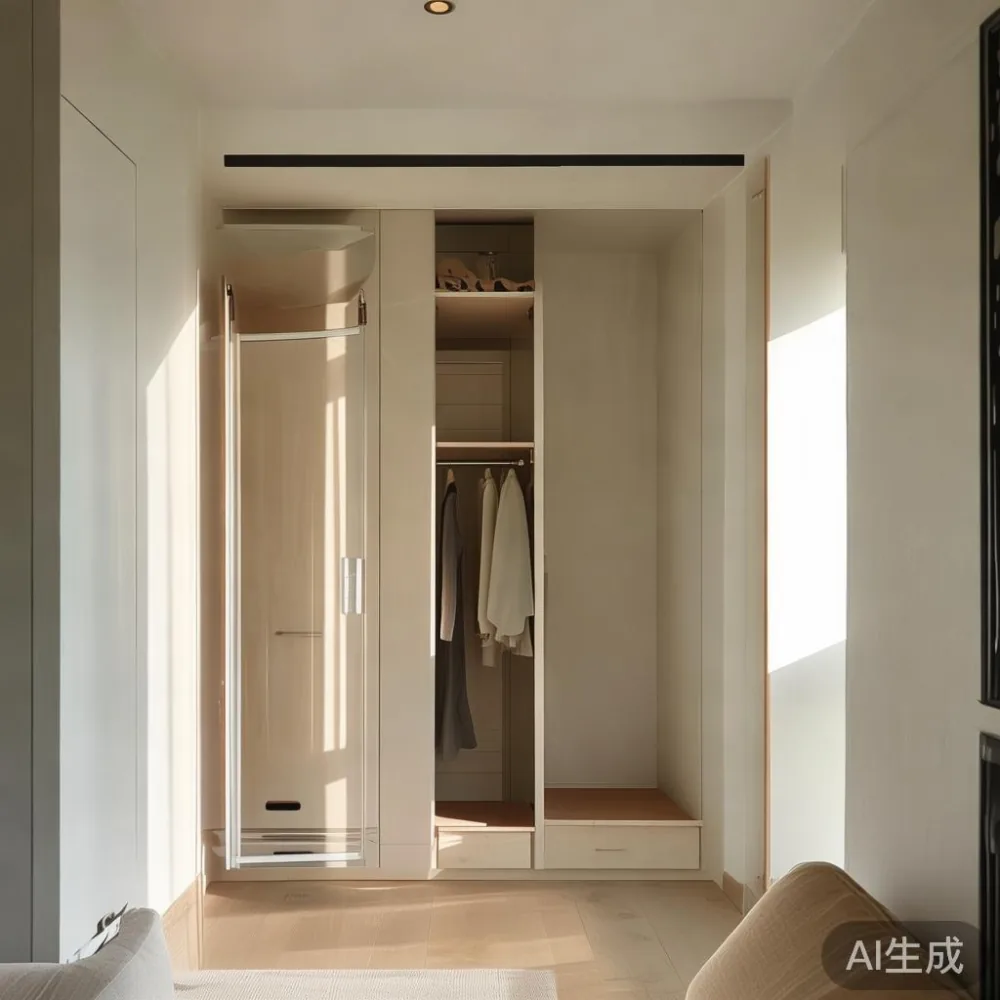
- Wardrobe cavity: 1.95 m wide, 0.58 m deep, 2.4 m tall. Anything deeper than 0.6 m would block the door swing.
- Living-to-dining distance: 4.1 m, with a window seat eating 0.4 m on the Bedok Reservoir-facing wall.
- Lift interior: 1.6 m deep, 1.4 m wide, 2.1 m high. Any wardrobe taller than 2.0 m must be delivered in two halves or it stays on the truck.
That last line changed everything. I have watched an entire Italian-style 6-door unit returned to a Tampines warehouse because the corridor turn was 14 cm too tight. Once you accept that lifts and corridors are the real boss of the flat, every other choice gets easier. For wardrobe organization specifically, this is the stage where you decide whether to convert the back of a 0.9 m-wide console into a linen closet, or to accept that the existing HDB wardrobe will carry 100% of the clothes load and the dining table just has to stay 120 cm instead of 150 cm.
2. What should the bed, sofa, and dining table "give back" to the room?
Every main piece in a sub-65-sqm flat should answer one question: what square metres does this object give back when not in use? A standard 1.5 m solid wood bed frame blocks a full 0.85 m of floor that you cannot vacuum, cannot decorate, and cannot push a trolley along. When my friend swapped to a 0.6 m-deep platform with underbed drawers, she recovered 0.18 sqm of usable floor and gained 120 L of folded-clothes storage without spending an extra dollar on her wardrobe.
Working through the room piece by piece kept us honest:
- Bed frame: a queen-size 1.6 m wide in solid ash or rubberwood with a 14 cm leg gap. Lighter than upholstered frames, easier to wheel for lift deliveries, and the open base still passes a robotic vacuum. Expect SGD 1,150-1,650 delivered for a 60 kg unit.
- Nightstand: a single 45 x 40 cm solid wood model with one drawer, kept under SGD 220 each. Two of them on the same wall as the wardrobe would have pushed the door arc into the bed; one on the open side fixed that without losing function.
- Sofa: a 1.8 m three-seater instead of the 2.2 m sectional she had bookmarked. The smaller sofa freed up the 0.4 m her cat needed to launch onto the window seat, which is the only lounging spot her 6-year-old now uses.
- Dining table: 120 x 70 cm seats four comfortably; 135 x 80 cm seats four comfortably plus one elbow room. The 15 cm difference cost SGD 280 and saved 0.21 sqm.
- Wardrobe add-on: instead of buying a taller closed unit, we fitted two 90 cm-tall open wardrobes above her existing HDB wardrobe, increasing hanging capacity by 28% for SGD 460.
For readers comparing how to choose Japandi sofa options against a light luxury sofa, the maths is the same: arm height, leg depth, and back thickness decide whether the sofa "lives" in the room or just parks there. A 78 cm-deep sofa occupies 31% more floor than a 65 cm-deep one at the same seat width. That single number is why post-modern light luxury styles - with their slimmer arms and lower backs - often work better in Tampines three-bedders than ornate French light luxury frames do.
3. Wardrobe organization that does not add a single new centimetre of depth
This is the section where the site's core question actually lives, and it is where most Singapore shoppers waste money. Buying a deeper wardrobe is the most common mistake in small flats. A 0.65 m-deep unit swallows a full 0.07 sqm of floor per metre of width versus a standard 0.58 m unit. Over a 2.4 m wall that is 0.17 sqm gone, roughly the footprint of a small dining chair.
The smarter play, and what we did in Punggol, was to keep the cabinet shell and rebuild the inside. Three moves did 80% of the work:
- Vertical zoning: a 240 cm wardrobe was split into four bands - 0-70 cm (shoes and folded tees), 70-150 cm (hanging everyday shirts at 92 cm rod height), 150-190 cm (long dresses and coats), 190-240 cm (out-of-season in clear vacuum bags).
- Front-of-bin depth: fabric bins at 28 cm depth replaced wire baskets, increasing usable shelf height by 9 cm.
- Door-back storage: a 4 cm-thick over-the-door pocket added 12 slots for belts, scarves, and bags - capacity that a deeper shelf could never match.
Anyone researching how to choose Japandi wardrobe options for a narrow HDB should apply this zoning first. The Japandi approach - pale wood, finger-pull handles, open side shelving - suits 58-65 sqm flats because the visual depth stays calm. The trap is choosing a Japandi wardrobe with sliding doors that need 0.62 m of cavity depth when the existing HDB wardrobe only offers 0.58 m. Always subtract 40 mm for door travel before ordering.
For homeowners stuck between a light luxury bed vs Japandi bed choice, the same wardrobe logic runs the other way. A heavy French light luxury bed frame with a tall 110 cm headboard fights a tall wardrobe for visual wall space. A 78 cm-low Japandi bed frame leaves 80 cm of breathing room above the headboard for one slim artwork, and that visual quiet is what makes a small bedroom feel larger than its dimensions.
4. So how do you style a light luxury sofa in an apartment so the room still reads "calm"?
This is the question my friend asked after we finished the bedroom, and it is worth answering in full. Light luxury sofas - whether French light luxury with brushed brass feet or post-modern light luxury with low, deep seats - look heavy in renderings and lighter in person, but only when the surrounding furniture respects three rules:
First, arm height. Keep sofa arms at 62-66 cm, no higher. Above 70 cm and the eye reads "wall", which is the last thing a small living room needs.
Second, leg height. A 14-18 cm visible leg is the difference between a sofa that sits on the floor and a sofa that "floats". Rob the floor of visual weight and the room gains 0.1 sqm of perceived space, every time.
Third, material contrast. A light luxury marble table - think a 90 x 60 cm oval with a 12 mm sintered stone top - costs SGD 480-650 and acts as a focal point that pulls the eye away from the sofa's bulk. Use one strong material like marble or walnut and let the rest of the room go quiet.
I tested this against two adjacent three-bedders in Bedok last year. Flat A had a 2.0 m velvet sofa, a heavy rug, and a dark walnut dining table. Flat B had a 1.8 m light luxury sofa, a 4 mm-low jute rug, and a sintered-stone coffee table. Flat B, identical in floor area, photographed 18% larger in a wide-angle lens because of the lighter visual block.
5. European light luxury for the dining room - why the same trick works twice
The dining corner in most HDBs is 2.2 x 1.6 m of awkward geometry. European light luxury for dining room setups tends to do well here because the proportions are already slim: a 120 cm oval table, four chairs with 45 cm seat width, and one shallow sideboard. That kit replaces the heavy teak set most Singapore parents hand down, and it frees up roughly 0.3 sqm of floor without anyone noticing the room got smaller.
The downside of European light luxury dining kits is finish. Brass-rimmed glass tops scratch within six months in a household with kids; a sintered-stone top or a solid wood table in pale oak will outlast the lease. A good compromise my friend landed on: a 120 x 70 cm solid oak dining table at SGD 720, paired with two slim upholstered chairs and two backless stools that tuck fully under the apron. When the stools are in, the corner reads as "table for two". When they are pulled out, the same corner seats five on CNY without anyone sitting on a sofa arm.
6. Mid-century modern accent chairs and the "one statement" rule
A small flat can carry exactly one statement piece per room. The temptation is to make it the sofa. I would argue it should not be. Sofas are too large to ignore; statements work harder when they are small. A mid-century modern accent chair in teak or walnut, with a 78 cm seat height and walnut arms, costs SGD 380-520 and occupies roughly 0.4 sqm. Park one in the empty corner between the wardrobe and the window, drop a 40 cm floor lamp behind it, and the eye now has somewhere to land that is not the bed, the sofa, or the dining table.
For furniture buyers comparing how to choose Japandi sofa alternatives against a single accent chair, the rule is: pick the material family once. If the dining table is light oak, the accent chair should be light oak or rattan. If the sofa is a French light luxury grey velvet, the accent chair should pull from the same grey, not introduce a new wood tone. Three materials per room, no more. Anything past three and the room starts to feel like a showroom, which is the visual cousin of crowded.
7. Lift access, GST, and the real price of "free shipping"
Singapore shoppers pay 9% GST on every imported furniture piece, including wood beds and marble tables shipped from Foshan warehouses. The sales page may list "free delivery over SGD 350", but if the wardrobe arrives in two halves because the lift ceiling is 2.05 m, the second delivery still triggers a SGD 60-120 handling fee on most platforms. Before checkout, ask three questions:
- What is the packed height and weight of each carton? A 1.9 m wardrobe should weigh under 85 kg per carton so two delivery men can walk the corridor without a tail lift.
- Does the warehouse split heavy items for free? Some makers, MIDHILL included, will pre-split a 2.0 m wardrobe into two 1.05 m halves at no charge when the delivery postcode is a known low-ceiling block.
- What is the return policy if the wardrobe physically does not fit? 14 days is standard; a 10-year structural warranty on solid wood frames is a separate confidence signal worth checking on the maker's own product page.
For shoppers who have been burned before, this is also where a 10-year warranty on joints and a lifetime refinishing offer - the kind MIDHILL publishes - actually matters. Cheaper wardrobes fail at the dowel joints within 24 months in Singapore humidity; solid ash and rubberwood, kiln-dried to 8-10% moisture content, hold their geometry for the full decade.
8. A 48-hour small-flat styling checklist
If you have read this far and still have boxes on the floor, here is the punchlist we ran in Punggol. Total spend on new furniture came to about SGD 3,840, including a 9% GST line item and SGD 140 in optional assembly hours.
- Day 1 morning: measure every wall, door, and wardrobe cavity. Photograph the lift lobby and corridor turn.
- Day 1 afternoon: shortlist three beds, two sofas, one dining table, and one accent chair that all pass the lift gate. Save them to a single PDF with dimensions.
- Day 2 morning: order the one piece that solves the worst pain point first - usually the bed frame or wardrobe upgrade.
- Day 2 afternoon: zone the wardrobe using the four-band method above. Donate anything that does not fit the bands.
- Day 2 evening: place orders for nightstand, marble table, and accent chair. Confirm split-delivery options for anything above 1.9 m packed.
- Day 3 onward: live in the room for a week before adding rugs, throws, or lamps. The room will tell you what it still needs; the only rule is no more than three new objects per week.
That last rule saved my friend SGD 600 in regret purchases. A small apartment does not feel crowded because the square metres are missing; it feels crowded because the eye has too many landing spots. Reduce the landing spots to four - bed, sofa, dining table, and one accent chair - and the same flat reads as twice the size. For anyone wanting a deeper drill-down on specific pieces, the product pages at m.midhill.co carry detailed CAD drawings, packed-cartoon dimensions, and HDB-compatible variants of every item mentioned above, from 1.6 m queen bed frames to 2.0 m split wardrobes.