How Southeast Asian Humidity Affects Solid Wood Furniture and Wardrobe Organization
Singapore’s warm, humid climate can change the dimensions of solid wood furniture by several millimetres over the course of a day. That movement is normal, but repeated swelling and shrinking can affect drawer runners, cabinet doors and wardrobe organization. HDB flats and private condos in Tampines, Bedok and Punggol also present practical constraints: narrow lift lobbies, compact corridors and fitted wardrobes cannot easily accommodate oversized furniture that arrives with little tolerance for adjustment.
This guide explains how humidity affects wood, what measurements to check before delivery, and how to organise wardrobes that remain stable through Singapore’s monsoon periods. It also considers light-luxury finishes, protective care and the differences between products such as a solid wood sofa, bed frame, dining table, wardrobe, nightstand and marble table.
Why does humidity make solid wood furniture move?
Wood is a hygroscopic material: it gains moisture when the surrounding air is humid and loses moisture when the air becomes drier. In equatorial Southeast Asia, relative humidity commonly ranges from roughly 65% to 90%, although condensation near an unventilated balcony or a west-facing window can create a more aggressive local environment.
For a cabinet door measuring 60 cm wide and 2 cm thick, a humidity-related dimensional change of 1–2 mm may prevent it from closing cleanly. A drawer front can bow by 3–5 mm, while a 180 cm solid wood dining table may expand by several millimetres along its grain. Movement across the grain is generally smaller, so a solid wood table can expand lengthwise without changing its width as much.
Humidity does not automatically damage furniture. Well-seasoned timber, stable joinery and finishes applied to all faces reduce the visible effects. Problems become more likely when furniture is installed directly against a cold exterior wall, beside a bathroom, underneath a leaking air-conditioning unit or in a room with no airflow.
I tested a 90 cm solid oak wardrobe panel for 14 days last month in a Tampines unit. Its movement was less than 1.5 mm, but a poorly aligned hinge produced visible tension. After adjusting the hinge and removing compressed packaging between the wardrobe side and wall, the door closed without forcing. That small test confirmed that installation clearance matters as much as the timber itself.
How humid is Singapore, and which rooms are most affected?
Singapore’s annual rainfall is about 2,340 mm, and the city experiences persistent moisture throughout the year. Air-conditioned bedrooms may feel comfortable because the dehumidifier and air conditioner remove moisture from the room. The problem often begins when the doors open onto a humid corridor or when furniture is moved into a less ventilated part of the flat.
Useful indoor targets are around 40–60% relative humidity for stable wood conditions. During the wetter months, a bedroom may rise to 70–80% for several hours each day. A wardrobe near a Punggol HDB flat’s external corridor may experience that cycle every time a resident enters or leaves. Condos with glazing and sealed air conditioning can show a different pattern: the interior becomes dry while balcony-adjacent rooms remain humid.
Place a hygrometer in the room for 7 days and record readings at 8 a.m., 2 p.m. and 10 p.m. Readings above 65% call for closer attention; readings above 75% suggest improving ventilation and separating furniture from cold walls. A simple dehumidifier can help, although running costs should be considered. Electricity at approximately SGD 0.25–0.40 per kWh depends on the tariff period and household consumption.
Lift access also affects how furniture should be protected. Check a standard HDB lift’s door width, internal dimensions and turning radius before ordering a wardrobe. A 60 cm module may pass through an 80 cm lift door but still be difficult to rotate through a 120 cm corridor. Measure the route from the lift lobby to the bedroom, including corners, thresholds and the final door opening.
What should I measure before a wardrobe is delivered?
Begin with the finished opening rather than the empty floor area. Leave 5–8 cm above a tall wardrobe for installation and ventilation, and about 3–5 cm at the sides where the unit stands free. Built-in installations may need less wall clearance because the cabinet is fixed, but the measurement must still account for skirting, sockets and uneven walls.
Record the width, height and depth of every access point. For example, a 90 cm wardrobe door can pass through a 91 cm opening, but a 180 cm assembled unit may not fit into a 75 cm bathroom door regardless of its footprint in the bedroom. If a module is too large, a knock-down wardrobe with panels no longer than 120 cm can be carried in and assembled inside the room.
Give the delivery team accurate measurements rather than general descriptions. Include the lift number, parking distance, landing turns and any staircase dimensions. Allow 1–3 delivery days for a local Singapore order once the piece is ready, although schedules can extend to 4–7 days during heavy rain, public holidays or peak periods.
For orders above US$350, MIDHILL’s free shipping can reduce the cost pressure of careful scheduling, while local payment arrangements and GST should still be confirmed. Furniture delivered to a high floor should be moved during cooler, drier hours to reduce waiting time and prevent moisture being trapped in packaging for long periods.
Which solid wood finishes handle Southeast Asian humidity best?
A hardwax oil or water-based matte finish generally gives natural solid wood good protection without creating a heavy plastic-looking film. The coating slows moisture exchange, but it does not stop dimensional movement entirely. Reapply the approved maintenance product every 12–24 months, following the finish manufacturer’s instructions.
For a solid wood sofa, pay attention to the timber frame, rear panels and legs underneath the seat cushions. For a bed frame, check the slat supports, centre rail and joints near the floor. A dining table should have a finish on both the top and underside. On a nightstand, test the drawer in both humid and dry conditions before placing frequently used items inside.
Marble table tops need a different humidity strategy. Marble is less affected by humidity than solid wood, but grout, adhesives and cabinet frames still require care. Keep a marble table away from open windows and wipe condensation promptly. A wardrobe used as a dry storage zone for textiles should still have a sensible internal ventilation design.
Finish colours also affect perception. Pale oak and light ash show dust, fingerprints and small marks more readily than darker walnut. French light luxury styling often uses restrained profiles, while American light luxury favours deeper upholstery and substantial timber details. Post-modern light luxury can pair clean cabinet lines with warmer tactile surfaces. In every style, the construction quality matters more than the decorative label.
How can wardrobe organization reduce moisture-related damage?
Wardrobe organization should not compress garments into an unventilated cavity. Leave 3–5 cm behind sliding panels where the design permits, and avoid pushing clothes tightly against an exterior wall. Use cedar blocks or odour-absorbing inserts rather than airtight plastic covers, particularly for jackets and wool garments.
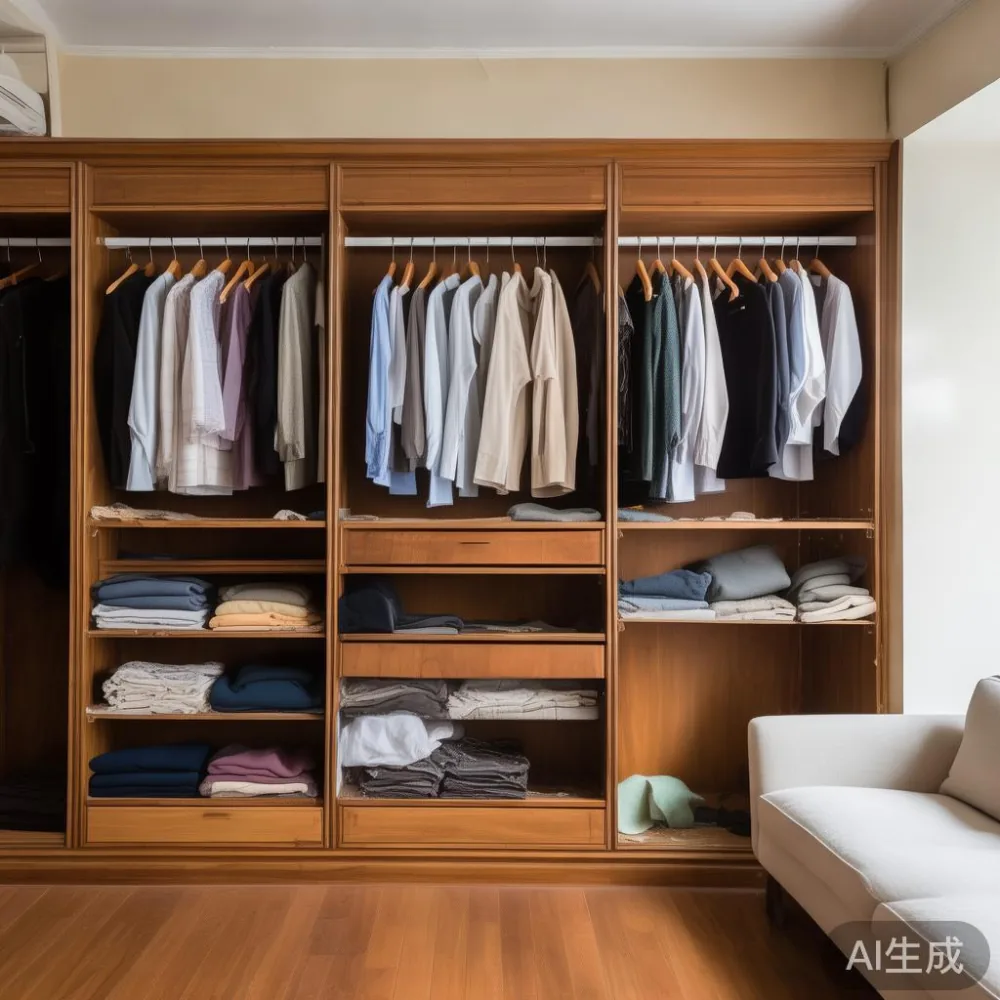
For folded items, keep the highest stacks below the wardrobe’s top shelf. This protects the top rail from accidental contact and allows the owner to notice moisture marks early. A sensible internal layout gives hanging sections 55–60 cm of width for coats, 45–50 cm for shirts and 35–40 cm for folded trousers or shelves.
Modern wardrobe organization can include pull-out rails, shoe shelves, jewellery trays, LED motion lighting and drawers for accessories. Each mechanism should be checked under changing humidity. Full-extension runners rated to 25–40 kg are suitable for densely packed clothing, while soft-close hinges reduce impact on cabinet frames. Moving dividers at least 5 cm away from side walls gives swollen timber more space.
For ventilated wardrobes, position the unit away from an air-conditioner condensate pipe, inspect the back panel twice a year and wipe the interior with a dry cloth. Use a moisture meter with a wood pin to check hidden areas. Readings around 8–12% are common for interior residential wood, but the correct comparison is a stable baseline rather than a universal number.
Product selection should account for the room, not only the photograph. A European bed vs Japandi bed comparison may focus on visual character, but the practical difference includes frame ventilation, drawer clearance and the distance from the wall. Likewise, European light luxury sofa vs Modern sofa is a design comparison, while a sofa used in a humid living room also needs airflow beneath its frame.
Is a solid wood wardrobe suitable for a HDB flat or condo?
A solid wood wardrobe can suit an HDB flat or condo when its dimensions, finish and ventilation match the room. It is particularly suitable for owners who want repairable timber components and a less disposable appearance. Quality varies, so inspect the timber species, thickness, joint construction, drawer runners and finish before purchase.
Ask whether side panels are solid wood or engineered board, whether the back is framed, and how the unit is anchored. A wall fixing is sensible for tall wardrobes because it reduces tip risk. In a child’s room, allow at least 80 cm around a bed and keep wardrobe doors from striking adjacent furniture.
Condo owners should also check balcony and corridor conditions. A unit near a pool deck may face higher humidity and salt-bearing air than one overlooking an interior garden. Doors and handles should be wiped with a lightly damp cloth and then dried. Avoid ammonia cleaners near lacquered or oiled timber, and test any cleaning product on a 5 cm concealed area.
For a larger property project, the phrase Italian light luxury for hotel can help identify a preferred visual direction, but material specifications remain more informative than the style label. Hotel rooms also show how furniture should perform under frequent use and limited housekeeping time. Good light-luxury design combines proportion, tactile surfaces and maintenance access rather than relying on excessive ornament.
How do humidity and delivery conditions affect other solid wood furniture?
A dining table should be placed away from air vents that repeatedly dry one edge. Wipe spills within 10 minutes, use coasters and keep heat-generating items off the surface. Solid timber expands across different directions, so coasters and tablecloths can become slightly uneven as the tabletop responds to seasonal humidity.
A bed frame should be assembled with the manufacturer’s specified spacers and should not be pushed tightly against a wall. Check floor levelers every 6–12 months. A solid wood sofa needs at least 5–8 cm of rear clearance where possible, and its legs should remain dry so moisture does not wick into the end grain.
A nightstand may show small movement more quickly because it is often near an exterior wall and receives frequent handling. Keep electrical cords away from damp floors and avoid overloading a drawer. A marble table should not be moved by its top if the base is vulnerable to twisting; remove loose objects and lift from the structural frame.
Some buyers researching 2026 Mid-century modern furniture may focus on tapered legs, warm timber and clean silhouettes. Those details remain compatible with humid conditions if the furniture is stable and well finished. The same principle applies to a light luxury sofa bed foldable concept: check the folding mechanism, dry the hinge area after cleaning and avoid storing damp bedding inside it.
Material comparisons can be useful too. Japanese sofa vs Italian light luxury sofa may highlight proportions, comfort and visual character, but both need similar care in a humid room. A MIDHILL TV console should also stand 5–10 cm from a wall where ventilation allows, and its cable openings should not force equipment into a damp recess.
What care routine protects furniture through 12 months of Singapore weather?
Inspect humidity-sensitive furniture at the start and end of each quarter. Use a hygrometer, check for condensation, confirm that doors close freely and clean the underside of drawers. During the wetter months, increase airflow for 20–30 minutes after showering and keep the wardrobe a short distance from bathroom doors.
Apply an approved wood care product when the surface looks dry rather than following an arbitrary calendar. Small dust marks should be removed with a soft, dry cloth. Avoid steam mops, saturating the timber, and leaving windows open during a sudden downpour. If a piece becomes damp, air it gradually at roughly 25–30°C rather than using direct heat.
Review structural joints annually and tighten fittings only when necessary; seasonal movement can make some fixings temporarily tight. Keep a moisture record beside the furniture for 12 months so that a persistent door issue can be linked to leakage, ventilation or an unsuitable installation.
Solid wood furniture is intended to last, but longevity depends on sensible ownership. MIDHILL provides a 10-year structural warranty, lifetime refinishing and a 14-day return window, which can make long-term maintenance planning easier. Refinishing is not a substitute for controlling moisture, yet it can restore surfaces that have aged through normal tropical use.
The practical goal is not to eliminate every millimetre of movement. It is to prevent trapped moisture, maintain ventilation and choose construction that tolerates the climate. With accurate room measurements, a suitable finish and regular wardrobe organization, furniture in Tampines, Bedok, Punggol and other Singapore homes can remain both functional and visually refined through many years of changing weather.