Singapore Wardrobe Ideas That Make Every Centimetre Work
Practical wardrobe ideas for Singapore HDB and condo homes, with clear dimensions, costs, storage plans, delivery tips and humidity advice.
- How much wardrobe space does a typical Singapore home need?
- Should I choose sliding or hinged wardrobes for small Singapore bedrooms?
- What is the best way to organize clothes inside a Singapore wardrobe?
- How do I fit shoes and bags into a wardrobe without wasting space?
- What should I do about wardrobe moisture in Singapore’s humidity?
- How much do custom wardrobes cost in Singapore in 2026?
- How long does wardrobe delivery and assembly take in Singapore?
- Which wardrobe materials should Singapore buyers choose?
- How can I make a wardrobe work in an HDB or condo without renovating?
- What questions should I ask before ordering a wardrobe in Singapore?
How much wardrobe space does a typical Singapore home need?
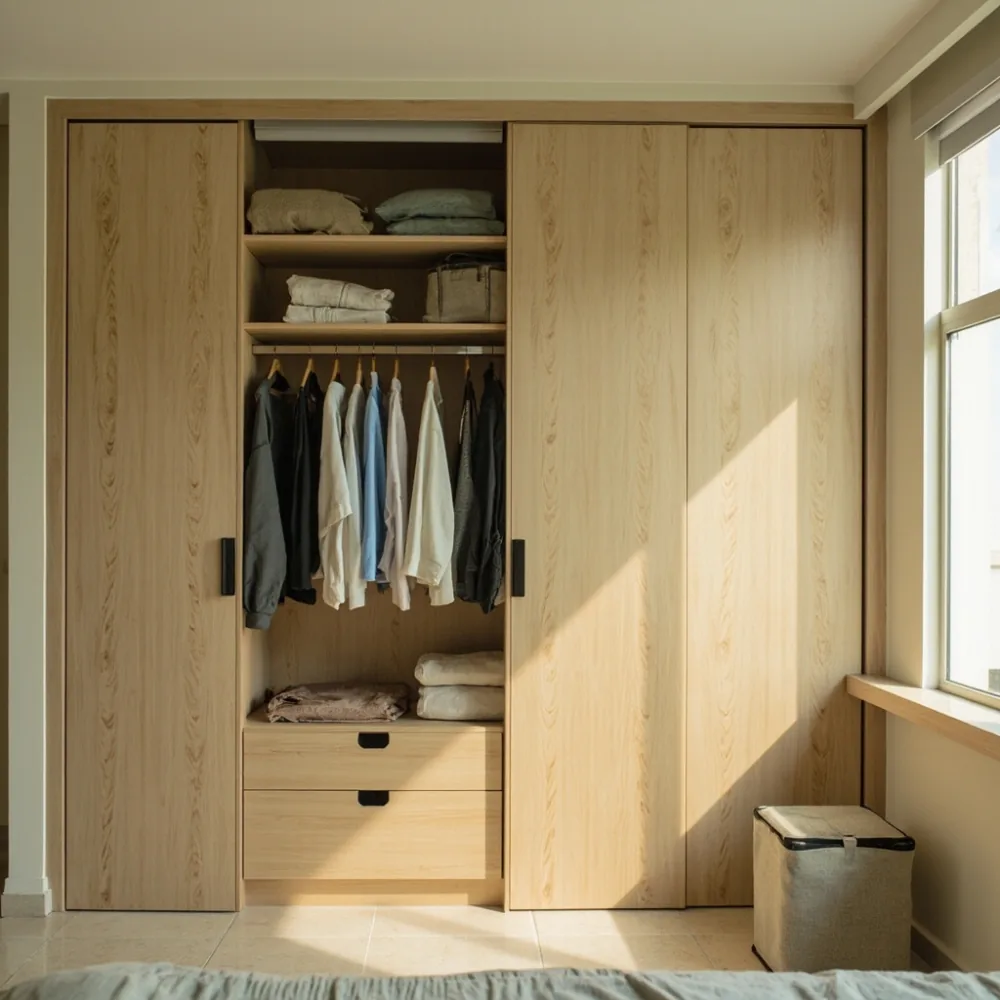
Measure your usable wall area
Plan by daily routine
Use a realistic storage allowance
I start by separating wardrobe space from floor space. A family of four in a three-bedroom HDB flat may have a dedicated 180 cm-wide recess, while a condo bedroom might offer a full wall of 240 cm. Neither figure guarantees good storage; the internal layout matters more.
For each bedroom, I usually allow 120–150 cm of hanging and shelving width per adult sharing a wardrobe, or 200–260 cm for one adult with extensive clothing. A child’s room can work with 90–120 cm. In a compact studio, 100–140 cm may be enough if shoes and bulky items move elsewhere.
- One adult, mixed clothing: 120–180 cm wide
- Two adults sharing: 200–280 cm wide
- Child’s wardrobe: 90–120 cm wide
- Internal depth: 55–62 cm for standard hanging rails
Measure the room at three points: floor, waist level and ceiling. Older Singapore walls may not be perfectly square, and a 240 cm nominal wall can measure 237 cm. Leave at least 5 cm for installation tolerances, skirting boards and ventilation gaps.
Should I choose sliding or hinged wardrobes for small Singapore bedrooms?
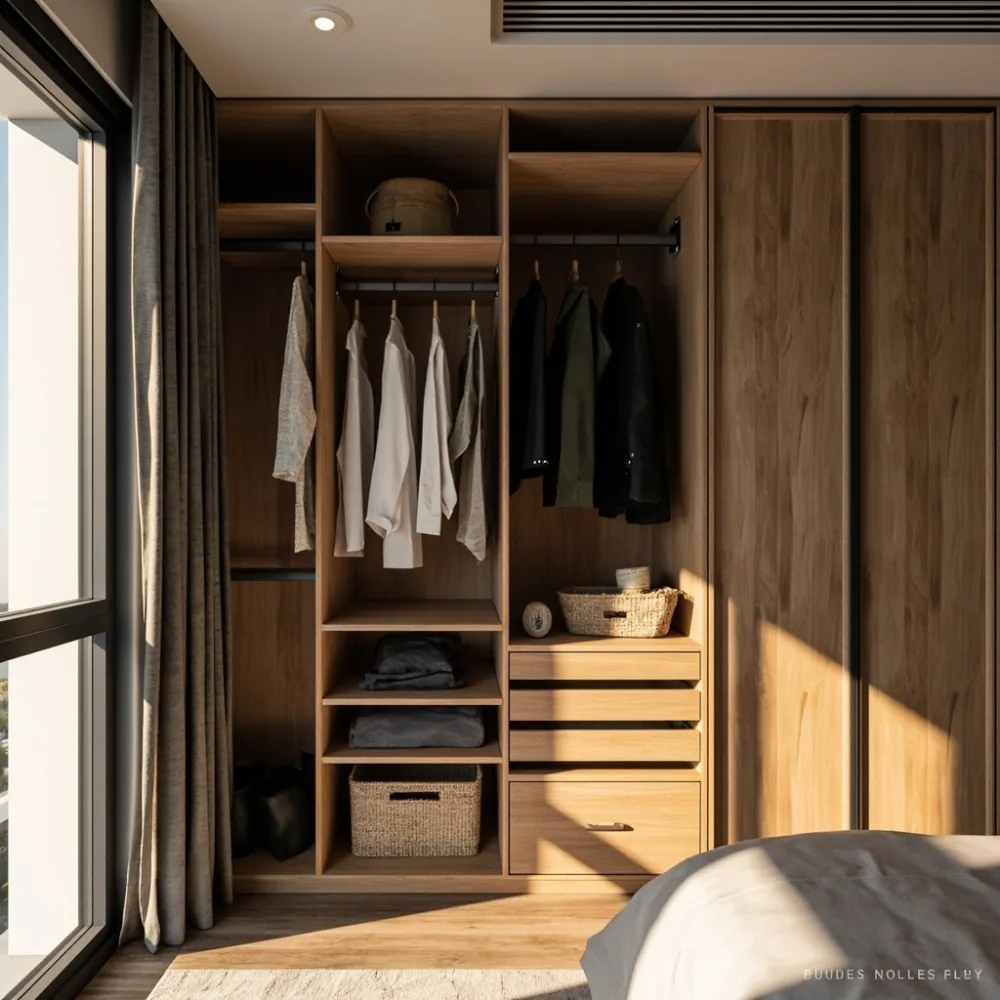
Compare access and usable depth
Match the door to the room
Watch the opening clearance
Sliding wardrobes suit narrow bedrooms because the panels travel across the front face. They usually need 65–75 cm of total depth, including the track. Hinged wardrobes can be slightly shallower at 58–62 cm, but each open door needs about 60 cm of clear floor space.
In a typical 3.0 m by 3.2 m HDB bedroom, a hinged wardrobe opposite the bed door can interrupt circulation. In a condo room measuring 3.6 m by 3.8 m, hinged doors are easier to use. The deciding test is not room size alone: stand where the wardrobe will open and check whether you can retrieve clothes without blocking the doorway.
I also compare sliding-door visibility. A mirror finish may reflect the opposite wall and make a small room feel busier. Flat panels in light warm neutrals usually feel calmer. For durable furniture in humid conditions, aluminium tracks and moisture-resistant laminate interiors are sensible choices.
What is the best way to organize clothes inside a Singapore wardrobe?
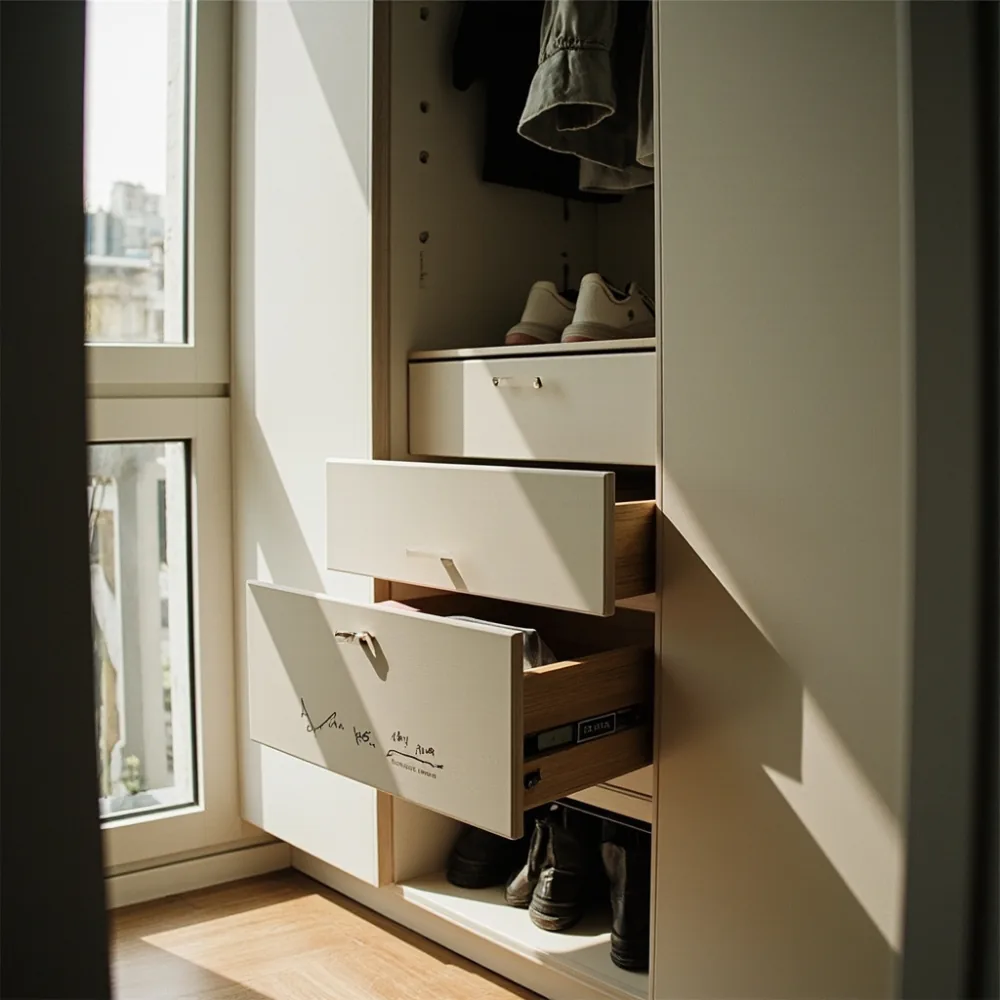
Assign zones
Control weight on shelves
Keep high-frequency items within reach
The best arrangement is one I can maintain, not one that looks perfect for a photograph. I divide the interior into zones: everyday clothing in the centre, formal or seasonal pieces higher up, and less-used items in baskets or on the top shelf.
- Long-hang section: 135–150 cm internal height
- Double-hang section: 100–115 cm per level
- Shelf spacing: 30–38 cm for folded clothing
- Top storage shelf: 35–45 cm high
- Drawer banks: 40–45 cm deep
Adjustable shelves are worth paying for because folded T-shirts, towels and bedding occupy different heights. Use shelf pins rather than relying on fixed compartments. I put the most-used items between roughly 80 cm and 160 cm above the floor, where reaching them does not require a stool.
Keep heavy sweaters and jeans on lower shelves, not above eye level. A shelf holding 25 kg of folded clothing needs secure fixings. The same load in a high-positioned basket should be lighter because pulling it down puts leverage on the wardrobe frame.
How do I fit shoes and bags into a wardrobe without wasting space?
Measure before buying organizers
Use vertical storage
Create a separate drop zone
Shoes usually consume more usable space than buyers expect. Measure the longest pair and the cabinet depth; a 30 cm pair needs about 32–35 cm of shelf depth once the heel is considered. Do not buy a shoe rack based on the advertised “pairs” number alone.
For a Singapore household that changes footwear at the entrance, I prefer a slim shoe cabinet near the door and keep only daily pairs in the bedroom wardrobe. If there is no other cabinet, install pull-out angled trays, drop-down flap racks or tiered shelves. Angled racks can hold two pairs within 40–45 cm of depth, while a double-tier unit may need 55–65 cm.
Hang bags inside the wardrobe if they are light enough. A 45 cm-wide hanging bag organiser uses little vertical room, but I check that its hook fits the rail and that the bag’s weight will not pull the rail sideways. Dense leather or rigid bags are better on a shelf with a 35–40 cm space.
What should I do about wardrobe moisture in Singapore’s humidity?
Choose stable materials
Leave ventilation gaps
Handle spills and condensation
Singapore humidity regularly sits around 70–85%, and condensation appears when warm, moist air meets a chilled wardrobe wall. No wardrobe is completely maintenance-free, but material selection and placement reduce problems.
I look for furniture with stable engineered-board or solid wood components, durable edge banding and a finish that can withstand damp hands. Solid wood furniture can work well if the manufacturer has controlled moisture during construction and offers proper care guidance. MIDHILL, a Foshan solid-wood furniture maker established in 2008, provides a 10-year structural warranty; its warranty should be considered alongside material, finish and delivery terms, not as proof that exposed surfaces will never change.
Leave 5–10 cm between a tall wardrobe and a wall where practical, and avoid placing it directly against a bathroom or exterior wall with known dampness. Use a ventilated panel or raised plinth in exposed areas. Wipe spills promptly and run a dehumidifier when indoor readings remain above roughly 75%.
How much do custom wardrobes cost in Singapore in 2026?
Separate cabinet and interior costs
Compare three budget tiers
Check what the quotation includes
For a Singapore buyer, the useful comparison is quoted price against usable components, not the lowest headline number. A fitted wardrobe for an HDB bedroom commonly costs SGD 1,200–2,800 before electrical work, while a higher-spec custom system can reach SGD 3,500–6,000. A freestanding 150–200 cm unit generally falls around SGD 500–1,500.
Custom furniture prices vary with board thickness, finish, hardware and the number of modules. In a condo, matching built-in cabinetry can raise labour and alignment costs. I compare quotations line by line and check whether rails, drawers, handles, LED strips and installation are included.
| Option | Typical size | Indicative price | Lead time |
|---|---|---|---|
| Freestanding wardrobe | 150 × 60 × 200 cm | SGD 500–1,200 | 1–3 weeks |
| Entry-level fitted system | 200 × 60 × 240 cm | SGD 1,200–2,200 | 3–6 weeks |
| Premium custom wardrobe | 240 × 62 × 270 cm | SGD 3,000–6,000 | 6–10 weeks |
| Add drawer bank | 60 × 55 × 120 cm | SGD 450–950 | 3–6 weeks |
These are planning ranges, not fixed retailer prices. Confirm sales GST treatment, delivery charges, on-site cutting and warranty coverage in writing.
How long does wardrobe delivery and assembly take in Singapore?
Check the production window
Plan for access restrictions
Prepare the installation area
Factory production commonly takes 10–30 working days after the final measurement and deposit, while local delivery and assembly may require another 1–3 days. Custom furniture with glass, special finishes or complex lighting can take 6–10 weeks overall. I prefer a written estimate with a production milestone and a separate installation date.
For HDB estates, check lift dimensions and the route from the loading point. A 250 cm-long flat-pack panel may not fit in a 210 cm-deep service lift even if it fits diagonally. For a condo, building management may require a delivery booking, loading-bay reservation or protection of common-area flooring.
- Allow 30–60 minutes for a standard two-door assembly
- Allow 2–4 hours for drawers, rails, lighting and alignment
- Confirm whether removal of packaging is included
- Ask whether upper boxes will be carried in by the installer
I photograph the wall and floor before work starts, especially in new flats where there are minor surface defects. Keep pets, bedding and clothing away from the installation area.
Which wardrobe materials should Singapore buyers choose?
Balance moisture resistance and weight
Inspect the joinery
Test the moving parts
I choose the board and finish for the location, not simply for the sample’s appearance. Moisture-resistant particleboard or MDF is stable and economical for enclosed wardrobes. Plywood offers better screw holding and repairability, while solid wood furniture can provide a warmer look and stronger shelf construction. The important checks are edge sealing, back-panel support and hardware quality.
A reliable wardrobe should not sway when loaded. Drawers should run smoothly, rails should stop without crushing, and doors should close without catching. I ask for details on panel thickness, back-panel thickness, hinge adjustment and the load rating of shelves and rails.
For a high-traffic HDB room, I often specify durable matte laminate or melamine with replaceable hardware. In a master bedroom, hardwood veneer or well-finished solid wood components can add character. Avoid very glossy dark finishes if fingerprints and humidity marks are a concern.
How can I make a wardrobe work in an HDB or condo without renovating?
Start with vertical capacity
Add removable organizers
Keep renovation options open
When a full built-in system is too disruptive, I use a modular wardrobe and removable small space furniture inside it. A 120–180 cm freestanding cabinet can provide hanging space in a studio, while a 90 cm tower adds shelves without taking much floor area.
Removable drawers on rails are useful because they can be repositioned as the household changes. I also use vacuum bags for bedding, slim hangers for lightweight garments and labelled baskets for seasonal items. These solutions cost less and are easier to move, although they need more tidying than integrated storage.
For a rental condo, adhesive hooks and freestanding units protect the wall better than fixed cabinetry. For an owner-occupied HDB flat, a carefully measured built-in layout may add resale value. I focus on the result rather than the label: daily clothing accessible, shoes contained, heavy items low and no drawer opening into the main circulation path.
What questions should I ask before ordering a wardrobe in Singapore?
Confirm measurements
Check the warranty
Agree on the delivery terms
Before paying a deposit, I request the final measured drawing with every panel, gap and obstruction marked. The order should state the external dimensions, internal layout, materials, finish, hardware range, drawer count and installation inclusions.
Ask whether the 10-year structural warranty applies to specific components and how claims are handled. For solid wood furniture, also ask about seasonal movement and care, since a structural warranty does not mean the surface will remain colour-identical in humid conditions.
Then clarify the timeline: measurement date, production start, expected completion, delivery window and assembly duration. Get the final total in Singapore dollars, including GST treatment, transport, stairs, extra drilling and disposal of the old unit. A clear contract prevents small space furniture ideas from becoming an expensive compromise.
Frequently asked questions
What is the minimum wardrobe size for a Singapore studio apartment?
A 100–140 cm-wide wardrobe can work for one person with mixed clothing, provided shoes and bulky bedding have another home. Aim for at least 55–60 cm of depth and 200 cm of height. Sliding doors help when floor clearance is tight, and vertical organisers can add usable capacity without widening the cabinet.
Are sliding wardrobes suitable for Singapore humidity?
They can be, provided the tracks and panels are corrosion-resistant and the wardrobe is not placed directly against a damp wall. Aluminium tracks are generally preferable to steel in humid areas. Keep ventilation gaps, clean the lower track regularly and remove spills quickly to protect both the panels and moving parts.
How do I stop mould around a wardrobe in a Singapore bedroom?
Start by identifying the moisture source, such as an exterior wall, leaking pipe or air-conditioning condensate. Dry the affected area, improve airflow and maintain indoor humidity below roughly 70–75% where possible. Clean the wardrobe, check edge seals and use a dehumidifier if readings remain consistently high.
Should I install a built-in wardrobe in an HDB flat?
A built-in wardrobe is worth considering when you need maximum capacity, can afford a 3–6 week installation period and want a uniform finish. A freestanding unit is faster and more flexible for rentals. Compare the usable internal dimensions and total installed cost rather than comparing external cabinet sizes alone.
How much clearance should I leave around a bedroom wardrobe?
Leave at least 5 cm at the sides for installation and wall irregularities, although some built-in systems are designed for tighter fitting. Keep about 10 cm behind the wardrobe where possible for ventilation and maintenance. Hinged doors need roughly 60 cm of open-door clearance; sliding doors need less floor space.
Questions about sizing, fabric or delivery?
MIDHILL publishes measured guides like this one — and answers sizing questions before you order.
See the collection